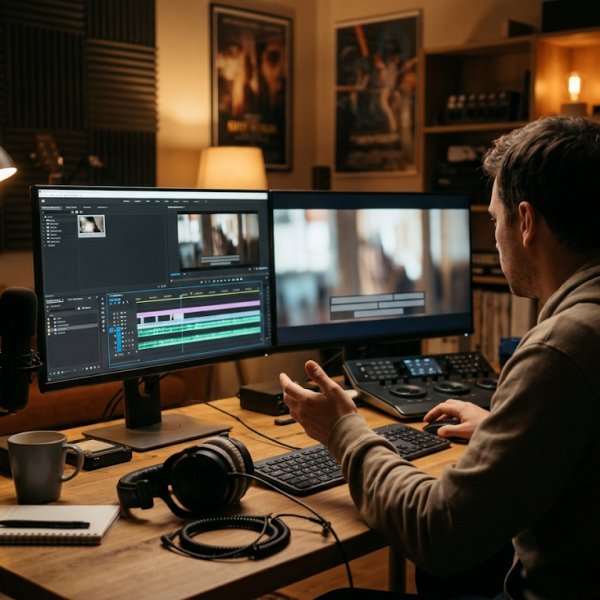
Video is now one of the most shared forms of content, and a growing share of viewers watch with the sound off or in a language that is not their first. A clip that explains a product, trains staff or tells a brand story can reach audiences far beyond its home market, but only if the words on screen and the words in the audio work for people who do not speak the original language. Subtitling and transcription turn spoken material into text that can be searched, translated and read on any device. Good subtitles are written for the eye, not copied from the ear, and that difference decides whether viewers keep watching or scroll away. This article explains how the process works, what to prepare before you start and how to avoid the mistakes that make subtitled video look amateur.
Transcription Comes First
Every subtitle project begins with an accurate transcript of what is said. A transcript records the words, the speakers and the timing, and it becomes the master text from which every language version is built. Errors at this stage travel into every translation, so it pays to use a careful human transcriber or at least a thorough human review of any automatic draft. Names, product terms and technical vocabulary deserve extra checking, because speech recognition tools often guess wrongly at them. Providing a glossary and the script, if one exists, speeds up the work and improves consistency. Once the transcript is approved, it can also be reused as a blog post, a help article or a set of social media captions.
Why Subtitles Are Not Just Translations
Subtitles have strict limits that ordinary translation does not. Viewers can read only so many characters per second, and each line must fit comfortably on screen without covering the speaker's face. That means the subtitler has to condense the message, cut filler words and split sentences at natural pauses, while keeping the meaning and the personality of the speaker intact. Timing matters as much as wording, since a subtitle that appears too early or lingers too long breaks the rhythm of the scene. The W3C guidance on captions and subtitles offers a useful reference for readability and accessibility, and it is worth sharing with anyone who edits your video files.
Choosing Languages and Markets
Not every video needs every language. Look at where your viewers actually live, which languages appear in your analytics and which markets you plan to enter next. Portuguese is a strong candidate for many brands because it opens access to Brazil, one of the largest online video audiences in the world. For campaign material that needs careful local phrasing, a specialist offering english to brazilian portuguese translation can adapt humour, units and expressions so that the subtitles feel natural to viewers in São Paulo rather than Lisbon. Spelling, formality and slang differ between the two varieties, and choosing the wrong one is an easy way to look careless.
Spoken Content and Live Events
Some projects involve more than recorded video. Webinars, panel discussions and customer meetings may need live interpretation as well as subtitles added afterwards. The two services call for different skills, and many buyers confuse them, so it helps to read this clear explanation of interpreter versus translator roles before you plan your budget. Recorded content gives the team time to polish every line, while live sessions need preparation, briefing material and a technical setup that supports audio for the interpreter. Decide early which parts of your programme are live and which are recorded, and book the right specialists for each.
Preparing Your Files
Smooth projects start with good source files. Provide the highest quality video available, along with separate audio tracks if you have them, and tell the team whether subtitles should be burned into the picture or delivered as separate files. Separate files are more flexible because platforms such as video hosts and social networks can display them in several languages from one upload. Share your brand style guide, including preferred spelling of product names and any words that must never be translated. If your video contains on-screen text, titles or graphics, send the editable files so those elements can be localised as well, rather than leaving a mixture of languages that confuses viewers.
Quality Checks Before Publishing
A professional workflow includes a review of the finished subtitles in context, with the video playing, because mistakes in timing and line breaks are hard to spot in a plain text file. Check that speaker changes are clear, that numbers and dates are formatted for the target audience and that sensitive terms are handled consistently. Test the files on the platforms where the video will appear, since some players cut long lines or change fonts. After launch, watch viewer retention and feedback, and update the glossary whenever new terms appear. With these habits in place, subtitled and transcribed video becomes a dependable way to reach new audiences, support accessibility and make every minute of footage work harder across languages and markets.